





The new bosses of Germany’s two largest series boatyards – HanseYachts and Bavaria Yachtbar – are united in their struggle with supply chains. They share their visions for the respective brands, and insights on how they are adapting to a fast-changing market

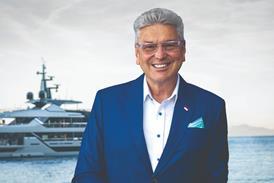
The CEOs of Hanse Yachts AG, Hanjo Runde, and of Bavaria Yachtbau, Marc Diening, have a number of things in common: both are in their mid-40s, have been in office for considerably less than a year, and are new to the leisure marine sector – they also assume management for Germany’s two largest series production boatbuilders in arguably the most volatile period for the boating sector in decades.
IBI talked to the two men about their respective visions for their businesses and the strategies needed to negotiate the myriad of challenges and opportunities the modern market presents.
Q. How has your company weathered the past two years – with Brexit, pandemic, problematic supply chains and now the Ukraine war?
Marc Diening, Bavaria: It has certainly been the most turbulent two years the boating industry has experienced in recent decades. In the first months of the pandemic there was a lot of uncertainty, also because no one knew what would happen to demand. After three or four months, the tide turned completely: Then it was only a question of how we could optimally map the surge in demand.
Once we were sure that this trend would continue in the medium term, we found the staff we needed to process the incoming orders with the appropriate lead time and new work processes.
It is extremely difficult to say what effects the Ukraine war will have - viewed from today - in twelve or 18 months. No one knows what impact it will have on global supply chains.
Hanjo Runde, Hanse Yachts: It was above all the effects of the pandemic that caused problems for the entire industry, first and foremost due to high absenteeism. And it is currently much more difficult to recruit employees because the willingness to relocate is no longer as high as it used to be.
Since the beginning of the pandemic, we have taken quite intensive measures to protect the staff. We have managed to keep our production lines running despite the major issues in the Corona period, which is also in the interest of the customers.
Q. Mr Runde, is the Ukraine war also being felt by Hanse, especially at its location in Poland?
Hanjo Runde: We are following developments with the Ukraine war with great dismay and consternation. We ourselves have over 120 Ukrainian employees and a considerable number of them have gone to war. We will probably not see them for an indefinite period of time.
At the moment, it is not so much about economic aspects, but rather about how we can help: with donations in kind or very pragmatic things like accommodation. I am reluctant to look at the economic aspects.
Q. What is the current situation with the order book? And how quickly are the orders processed in view of compromised supply chains?
Hanjo Runde: Apart from issues such as missing parts and staff shortages, which we manage on a daily basis, there is also a positive effect: we have an order book – as of February 2022 – of €330m. That is a record level.
This is countered by the fact that there are major problems in the logistic chains to finish the boat and then deliver it to the customer. It is important to be transparent about where the current problems are. We are currently experiencing delays; I think that is understandable.
”We would like to process the order book faster. Today, depending on the model, we have delivery times on the order of 18 months.”
– Bavaria’s Marc Diening
The Ukraine crisis will have massive consequences because logistic capacities are reduced and currently much slower. It looks like Hanse is not as affected by the availability of missing parts as far as our suppliers are concerned.
Marc Diening: We have an extremely strong order book. We would like to process the order book faster. Today, depending on the model, we have delivery times in the order of 18 months, sometimes a little longer.
The demand level is so high that the supplier base is not prepared for it to a large extent. This does not only affect Bavaria, but all shipyards: often the same suppliers are used, who have the challenge of producing more than before with a difficult supply chain situation that will probably last another 12 to 24 months. This is especially true for engines and electronics, and sometimes also for wood and castings.
Q. Costs are rising continuously, inflation is on the rise: What is the pricing policy? For what period can you assure customers the purchase price if they order today?
Marc Diening: It is a real challenge to forecast the prices of suppliers and materials, we have not seen such increases in recent decades and we assume that this will continue.
We have sold all orders at fixed prices so far. If we continue to do that, we are probably building in too much of a buffer. That would be to nobody’s benefit. For me, it is important to keep the product affordable now.
Hanjo Runde: Massive price increases for raw materials cannot be denied, which means that prices for boats will continue to rise. A boat ordered today has the calculated price for the expected delivery date. For example, if you order a Hanse 60 today that will be available from spring 2024, you will pay a price that includes the increased energy prices, wages and material costs that we expect by 2024.
Q. The 2022 Düsseldorf boat show was cancelled very late. Do you want to exhibit again in 2023?
Marc Diening: For me it is quite clear that Düsseldorf was and is the world’s leading trade fair. We are already planning for 2023. I assume that boot will clearly remain the most important trade fair for us in the coming years.
Hanjo Runde: Messe Düsseldorf was right to cancel boot and thus fulfilled its social responsibility. I don’t think it’s foreseeable today what role the pandemic will play. Perhaps there will be a new variant, and that will of course influence our decision.
The survey of our partners on the future of trade fairs showed that digitalisation is generally gaining in importance and that partners tend to focus on smaller in-house events and inwater trade fairs.
Q. Where do you see the most promising economic prospects for your company? More in sailing, more in motor yachts, more day cruisers or boats for the long haul?
Hanjo Runde: At the moment, all our brands are doing better than average. Probably also because we have focused our development work on models that - like the Fjord 41 XL, the Hanse 460 or the entry-level boat Ryck 280 - are unparalleled.
At Privilége we have an order backlog of €53m, which is a record: we intend to significantly increase the capacity and efficiency of the plant. Buying more brands makes much less sense than entering another multihull segment with an existing brand.
Of course, individual market segments develop differently and are also subject to fluctuations. That is why we have a multi-brand strategy. That is also a kind of risk management.
Marc Diening: We are generally in the 30 to mid-50ft range. That is a larger segment than we believe we will be able to serve well in the next few years.
Traditionally, we come from the sailing segment: we see a new dynamic in the sailing segment in the last two years, which is still our most important core segment also in terms of turnover.
The new products we have launched in the last two or three years are doing extremely well - on the sailing side with the Bavaria C42 and C38, where we are selling triple-digit numbers per year, and on the powerboat side with the SR line, where after the well-received SR 41, we are now introducing the SR 36.
Q. What new boat models can we expect for 2023?
Marc Diening: The Bavaria SR 36 is certainly not the last model in the SR line. In the powerboat segment, we will gradually replace models, and in the sailing segment, we will expand the series, which is very well received in both the owner and charter markets. In both main segments we will see novelties in the next year or two.
Hanjo Runde: We have just done a major analysis of how individual market segments are developing and what can be derived from that. One thing I can say is that we will have more developers and increase our speed of innovation.

Q. How is Hanse’s design office in Poland developing?
Hanjo Runde: We have seven employees in Baltic Design Institute and will add another 25 colleagues, regardless of the location. I find it fascinating how engineering colleagues from France, Germany and Poland work together. The first prototype, which our Baltic Design Institute played a major role in working on, is currently being built in Greifswald.

Both series boatyards in Germany are owned by financial investors that tend to have a medium term exit/sale strategy. What is the plan for Bavaria’s owners?
Marc Diening: I think one of the key points for Bavaria’s future success is a certain consistency, sustainability and a clear, implementable strategy. That is exactly what has been discussed and agreed with the investor. We have the same ideas about what Bavaria needs: to return to its core positioning, then set a clear course and stick to it over several years, so that we can then reap the rewards of what we invest in new products, staff and skills.
It is clear that this takes time, and the investor brings this time with him. The investor is very satisfied with Bavaria’s development over the last three years, even though Corona was not included in the original business plan.


LinkedIn
X / Twitter
Facebook
Email us