With growing consumer interest in environmental sustainability, boat builders look to future technologies as a means of solidifying their engagement with eco-conscious buyers. But what can the industry do right now to be more sustainable? Quite a bit, it turns out, with a range of green options already available to boat builders

With major trade events like METSTRADE and CES increasingly focused on emerging technologies aimed at making boating more environmentally sustainable, one could be excused for believing that opportunities to reduce the sector’s ecological footprint will only be achieved one day, some day, when all this experimental future tech becomes everyday reality.

Yet boat buyers are increasingly asking for greater sustainability right now, not years into the future. So what can the industry do today to lessen its ecological impact?

Plenty, it seems, as evidenced by sustainable options presented at recent trade events. Here’s just a sample of tech boat builders and service yards can employ right now to deliver a more sustainable product.

Propspeed

Propspeed hero

Having positioned itself for over two decades as a solution to keep running gear clean of marine growths, New Zealand foul-release coatings manufacturer Propspeed says one of the key environmental benefits of its product is that it allows vessels to immediately reduce greenhouse gas emissions through reduced fuel consumption.

In order to validate that claim, the firm recently collaborated with two Dutch firms – Stellendam, Netherlands-based shipyard Padmos BV, and Nieuwegein-based technology firm TechBinder – to perform controlled A-B testing of its product on a 38-metre commercial fishing vessel.

“In a nutshell Padmos said that if we could demonstrate a 4% fuel savings by using Propspeed, they would adopt it across their production and recommend it to their customers,” says Propspeed CEO, Marcus Hamilton. “For decades we have heard anecdotal reports that Propspeed has improved fuel economy for our customers, and this provided an opportunity to test and validate it using third-party professionals.”

A sheltered inland waterway at Deltageul was chosen for the sea trials due to its minimal tidal and weather variations, with Padmos volunteering the fishing tug Z-98 Windroos for the test. Freshly cleaned below the water line, the vessel followed a GPS-mapped route while a range of on onboard equipment from TechBinder recorded operational data such as navigational waypoints, engine performance metrics, shaft torque and fuel flow over a range of rpm intervals.

“The take-away from this third-party study is that the application of Propspeed stands to reduce on average 4.5% of fuel burned, and the correlated greenhouse gas emissions into the atmosphere, compared to a cleaned propeller from the moment it is applied”

The vessel then returned to the dock, where it was pulled from the water and had Propspeed applied to its propeller. Once the coating had dried, it was sent back out to run the same route again, allowing A-B performance comparison while mitigating as many potential variables as possible.

When the data was collected, validated and the final figures tabulated, Propspeed delivered an average 4.5% reduction in fuel consumption across the operational rpm range. Based on provided historic operating hours and average rpm, the Z-98 Windroos was calculated to theoretically save 996 litres of fuel on just one fishing trip with Propspeed applied.

“The take-away from this third-party study is that the application of Propspeed stands to reduce on average 4.5% of fuel burned, and the correlated greenhouse gas emissions into the atmosphere, compared to a cleaned propeller from the moment it is applied,” says Hamilton. “Driven by new environmental regulations and shifts in consumer behaviour, boat builders in both the commercial and recreational sectors are looking for ways to make their vessels more fuel efficient and less impactful on the environment. We deliver a high impact, low investment solution that allows them to achieve that, right now, without retooling anything or having to change anything else.”

Hamilton notes that service yards can offer their customers similar reductions in fuel consumptions and greenhouse gas emissions by applying Propspeed during refits. “Beyond that, Propspeed helps with reducing the spread of invasive species without the use of biocides, and is a key part of an effective cathodic protection system,” he says. “Our Stripspeed product for removing old coatings eliminates the need for grinding, reducing airborne particulates while dispensing with the need for tenting with plastic sheeting, lowering costs for the yard further and preventing even more material from going into landfills.”

CMP Group

CMP Used Anodes

Most boaters, boat builders and service yards never give a second thought to sacrificial anodes – those curious knobs of raw metal found on outdrives, shafts, rudders and other metal components that dangle under the boat. Anodes protect underwater metals from corrosion by being more attractive to sub-surface electro-chemical reactions than anything else nearby. Corrosion focuses on the replaceable anode, rather than more valuable metal drive shafts, rudders and props. The principle is a bit like catering a children’s birthday party by serving cake and broccoli at the same time – the cake gets devoured, while the broccoli escapes untouched.

Anodes have historically been made from zinc-based alloys – to the point they’re universally known as “zincs” than by their proper name. While zinc is an effective anode material, when found in high concentrations – such as in the water around marinas – zinc has been linked to a variety of serious health concerns and shown to be highly toxic to a wide range of aquatic plants, invertebrates and fish.

What’s worse, zinc anodes frequently contain additives like cadmium, an element that has been conclusively associated with serious illnesses including kidney disease, atherosclerosis, hypertension and cardiovascular diseases. In other words, not exactly a product that’s in keeping with greater sustainability and a reduced ecological footprint.

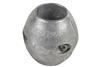
More sustainable alternatives to zinc have been available for years, but are still finding their way into widespread use. Anodes made from aluminium alloys are completely non-toxic and 100 percent cadmium-free, and actually outperform zinc when it comes to protecting boats whether used in freshwater, saltwater or brackish environments. “Most major engine manufacturers now include aluminum anodes on their products instead of zinc,” says Michael Szwez, vice president of retail sales / marketing for Canadian anode manufacturer CMP Group. “Mercury, Suzuki, Yamaha, Volvo Penta to name a few have all embraced aluminum as an alternative to zinc.” 

Further advantages to anodes made from aluminium alloy include significantly lighter weight for easier handling and lower shipping costs, and greater durability in use, typically lasting up to 50 percent longer than zinc anodes of comparable size. Ironically, the greater life span of aluminium anodes has led to sales resistance when boaters come to buy replacements.

CMP Martyr shaft anode

“Aluminium doesn’t erode anywhere near as quickly as zinc does, so customers look at the anode and think it isn’t working,” says Szwez. “If anything, we as an industry haven’t done a good job of communicating the fact that aluminium anodes simply last longer and represent greater value.”

CMP Aluminum anodes for shafts

Szwez adds that boats operating exclusively in freshwater environments have an even better alternative available in the form of magnesium. With its extremely active electro-chemical voltage range, magnesium-based anodes offer a substantial protection edge that surpasses that of zinc and even aluminium. “The bottom line is, nothing is more effective than magnesium,” says Szwez. “It’s also completely non-toxic and doesn’t contain any cadmium whatsoever. We don’t recommend magnesium for use in saltwater because its electro-chemical range is a bit too active, to the point it dissolves so quickly that it could leave the hull temporarily unprotected if the owner doesn’t notice. In the ocean, the stuff dissolves like an antacid tablet. But in freshwater, magnesium is far and away the best protection you can get.”

“The application resulted in 996 litres worth of fuel not being burned, and 996 litres worth of greenhouse gas emissions not being emitted into the atmosphere”

More importantly, both aluminium and magnesium represent a more sustainable alternative to traditional zinc anodes – a positive step forward than any boat or engine builder can leverage right now.

Hempel A/S

While Propspeed and CMP focus on running gear protection and anodes respectively, Danish coatings manufacturer Hempel A/S offers boat builders, dealerships and service yards another opportunity to deliver more sustainable products today with its Silic One bottom paint. Described as a silicone-based coating containing no biocides whatsoever, the product leaves the vessel with a super-slippery bottom that marine growths can’t adhere to, allowing water pressure alone to clean them off once the vessel begins moving at a speed of five knots or more.

Hempel Silic One application 1

What’s more, the product creates an invisible hydrogel microlayer that forms between the coating surface and the water. Fouling organisms perceive this layer as liquid, according to the firm, discouraging them from even attempting to take hold to begin with.

Traditional bottom paints fall into one of two varieties – ablative coatings which the paint continually erodes to reveal fresh layers of biocides, and non-ablative finishes in which it is the biocides rather than the paint which erode as they continually leech into the water. In either case, hulls need annual repainting, while considerable quantities of toxic matter are released into the environment over the span of the coating’s service life.

As with zinc anodes, high concentrations of bottom paints in locations such as marinas can lead to water quality degradation and harm to a variety of sea life beyond the organisms targeted by the coatings. This has led to increased demand for non-toxic, biocide-free alternatives to traditional bottom paint – especially in the US, where a number of state governments have called the use of biocide-based bottom paints into question.

Hempel Silic One application 3

Hempel introduced its Silic One biocide-free bottom paint in the US market at the 2023 IBEX trade show through its North American partner, SeaWide Marine Distribution, picking up an honourable mention in the IBEX Innovation Awards in the process. 

Hempel Joe Graves SeaWide

“Silic One is a far more sustainable product in two ways,” explains SeaWide Marine Distribution product manager, Joe Graves. “Obviously, being biocide-free it doesn’t leech any toxins into the environment, which is clearly a big win. Second, it’s very slick, so it reduces drag from the hull passing through the water. The benefit is that the boat uses less fuel and, as a result, emits fewer greenhouse gasses. I’ve heard reports from boat yards in Denmark where they’ve been using the product for years claiming fuel savings of up to 30%. I can’t verify that, but I do know the numbers we’ve seen on test boats that we did physical trials with, before and then right after being painted with Silic One. Our numbers come up with a 4% average gain in speed, and a fuel economy improvement of anywhere from 7% to near 20%. Even at the conservative end, that’s a huge improvement.”

Hempel Silic One hero

Graves adds that because Silic One doesn’t continually leech matter into the water, the product offers a greater service life than traditional bottom paints which must be re-applied annually. “We say it’s a two-year paint,” he says. “After two years the boat is pulled out of the water, cleaned, and one coat of Silic One is applied to the hull. That process can be repeated five times before the hull needs to be stripped. It saves the end-user a lot of money, and it saves the yard in labour, since they can turn the boat around quickly. And it’s biocide free, so you’re not exposing employees to toxins.”