






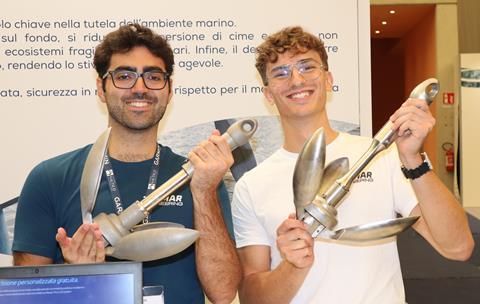
The Abissa anchor has been designed by two young engineers to free itself when caught on the seabed. The team is now seeking a manufacturing partner
Anchoring in a busy bay, with criss-crossing rodes, or where the seabed is full of rocks, can lead to the anchor being fouled. Retrieval can be difficult as the flukes of the anchor are designed to stay rigidly in place.
But what if they weren’t? What if they could give way when sufficient load was applied and effectively release themselves from the obstruction?
After much experimentation, the founder of Zefmar Engineering, Riccardo Gerbi, hit upon a design of three-fluked grapnel anchor where a spring loading mechanism allows any one of the flukes to fold further out when it becomes snagged. The trick was to ensure that the anchor was able to provide good holding in settled conditions, but break-out when excessive force was needed. Each fluke can fold back to 180o to allow it to slip under a snagged line or give a better angle for pulling free from a rocky crevice. In normal use, a sharp pull will break it out with relative ease. This type of release mechanism also reduces damage to the seabed, and to any underwater infrastructure that may have snagged the profiled flukes.
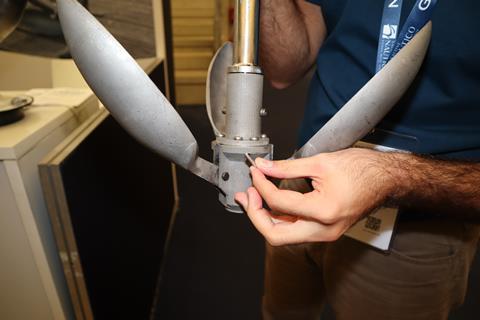
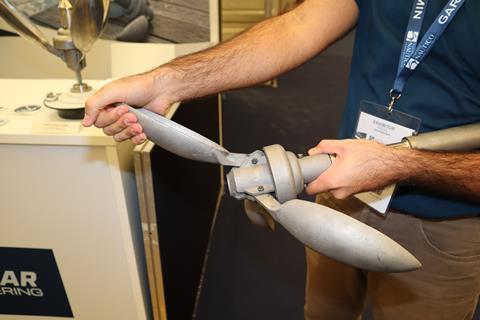
For holding in bad weather, a pin is attached which locks a collar down, so the Abissa performs as a standard, rigid-fluke anchor. The spring loading mechanism is effectively overridden. An eye can also be attached to the base so a break-out line can be attached if necessary, connected to a marker buoy on the surface.
Due to the costs of making patterns, Gerbi arranged for the first few working prototypes to be 3D machined in stainless steel, using prize money from a start-up competition where he excelled against 200 other ideas. A specialist 3D printing company in Turin assisted with making every component except the shank.
The target for boat size for the 6.4kg anchor is up to around 8m, and the team are now looking to create a larger four-fluke version. They need a manufacturing partner to take the design forward.
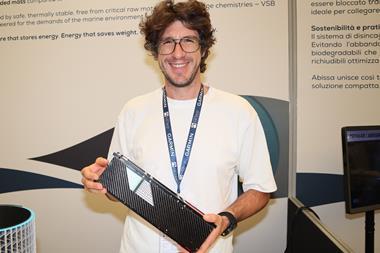
“The prototypes are about 95% there,” Gerbi said. “There are just a few minor details to finish, and then its ready for mass production.”


 LinkedIn
 X / Twitter
 Facebook
 Email us