





Metro Marine Lighting designs and manufactures a full line of marine lights with industry-first, patented anti-biofouling and anti-condensation technologies

The company was approached in 2012 to light the perimeter of rocks around an island in the Long Island Sound. “The owner of this island wanted to see the perimeter illuminated at night, and at high tide. It was a substantial project that would have involved hundreds of light fixtures in the water. But marine growth is extremely aggressive. We installed one test fixture, and when we checked it one week later we realised we had a problem, because even if you began cleaning the growth off a number of the lights every day, they would be fouled all over again before you’d have made it halfway around the island,” explained Metro Marine Lighting president, Daniel Deutsch. “We realised there was a problem that really hadn’t been addressed. How do you keep a lens free of seaweed, barnacles and all other kinds of marine growth?”

ad3ff2cc-3cce-a0ab-2763-7fc8e7cc8c81

Deutsch knew that Ultraviolet C (UVC) lights were widely used in water purification plants and felt that newly emerging UVC emitters in LED form could hold promise. “We purchased a number of these UVC LEDs and began doing some testing – we were really quite stunned by the results,” he says. “In building commercially viable fixtures, we had to do a lot of additional research, because UVC likes to break down certain materials – like O-rings and seals – so we had to test over a dozen sealants to find ways of making that work.”

While the UVC LEDs solved the biofouling problem, they didn’t address every challenge, says Deutsch.

“We also recognised that condensation was another problem in underwater fixtures, so we built a clean room in our factory with a vacuum chamber set up in it, allowing us to remove all the air from inside the lighting fixtures’ housings and fill them with clean, dry nitrogen instead, eliminating any possibility of condensation. We patented both processes – the use of UVC LEDs and an assembly process for using dry gas in our fixtures. Now we have a fixture design that has solved both of these problems, and we’re always amazed at how well our technologies work. We’re very pleased with the results.”

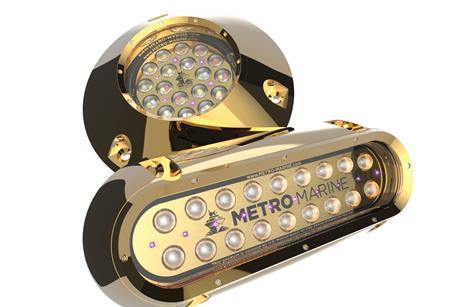
The newest evolution of this journey is represented in the company’s recently introduced F-Series underwater lighting fixtures. Incorporating 72 high-output LEDs per fixture, the F-Series lights allow for close adjacent placement where fully mixed, uniform light is important. The full-spectrum RGBW lights further integrate white LEDs with the RGB LEDs in order to create higher-quality whites and even richer colour blends than what is possible with traditional RGBW offerings. Available in a choice of 18 individually optically lensed RGBW LED configurations in both round and elongated housings, F-Series fixtures illuminate mid- to large-scale structures and yachts ranging from 32 feet to 100 feet, with uniform colour control and high efficiency.

Designed to be mounted at a depth of up to 15 feet below the water’s surface, F-Series lights use watertight aluminium-bronze housings and hardware for mounting on yachts, docks, seawalls, marina facilities and even fountains in theme park installations.